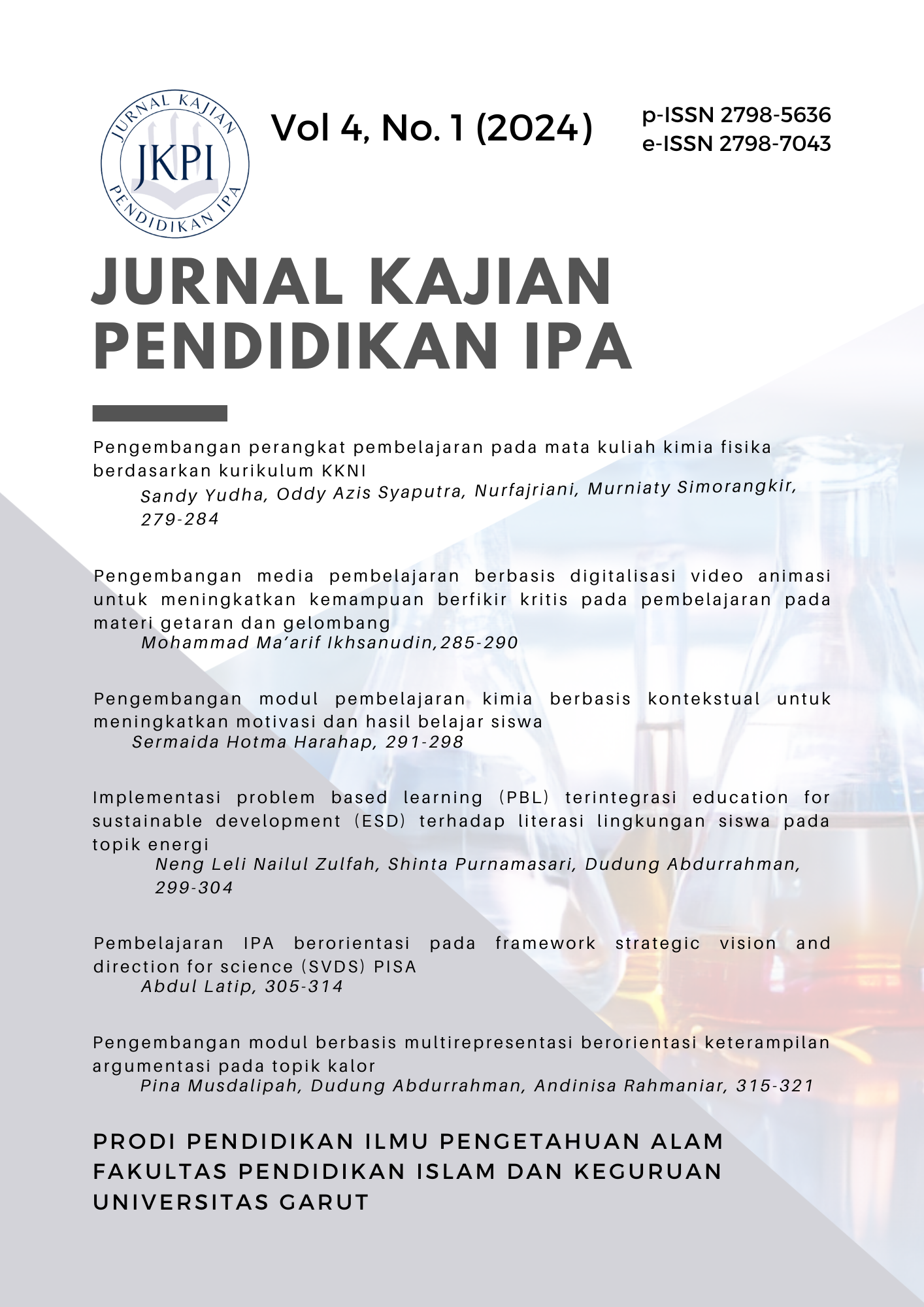
Pengembangan modul berbasis multirepresentasi berorientasi keterampilan argumentasi pada topik kalor
DOI:
https://doi.org/10.52434/jkpi13351Abstract
Penelitian ini bertujuan untuk mengembangkan modul pembelajaran yang berbasis multirepresentasi dan berorientasi pada keterampilan argumentasi pada topik kalor. Metode penelitian yang digunakan adalah Research and Development (R&D) dengan model pengembangan 4D yang dimodifikasi menjadi 3D terdiri dari tahap define, tahap design, dan tahap develop terbatas yaitu pengujian kelayakan produk yang dikembangkan. Penelitian ini melibatkan siswa kelas VII SMP sebagai sampel penelitian. Instrumen yang digunakan berupa lembar validasi bahan ajar diisi oleh dosen ahli dan guru IPA. Hasil pengisian lembar validasi tersebut dianalisis dengan menghitung presentase kelayakan lalu dikategorikan dalam rentang presentase kelayakan bahan ajar. Hasil penelitian yang diperoleh melalui uji kelayakan aspek materi, penyajian, dan bahasa dalam tahap develop terbatas menunjukan bahwa pengembangan modul berbasis multirepresentasi keterampilan argumentasi pada topic kalor memiliki kategori layak. Berdasarkan hasil tersebut dapat disimpulkan bahwa bahan ajar berupa modul yang dikembangkan dapat digunakan dalam proses pembelajaran.
Downloads
Published
Issue
Section
License

This work is licensed under a Creative Commons Attribution-ShareAlike 4.0 International License. Authors who publish with this journal agree to the following terms:
- Authors retain copyright and grant the journal the right of first publication, with the work simultaneously licensed under a Creative Commons Attribution-ShareAlike 4.0 International (CC BY-SA 4.0) License, which allows others to share the work provided that the authorship and initial publication in this journal are acknowledged.
- Authors may enter into separate, additional contractual arrangements for the non-exclusive distribution of the journal-published version of the work (e.g., uploading it to an institutional repository or publishing it in a book), provided that the initial publication in this journal is acknowledged.
- Authors are permitted and encouraged to post their work online (e.g., in institutional repositories or on their own websites) both before and during the submission process, as this can lead to productive exchanges, as well as earlier and greater citation of the published work (see The Open Access Effect).