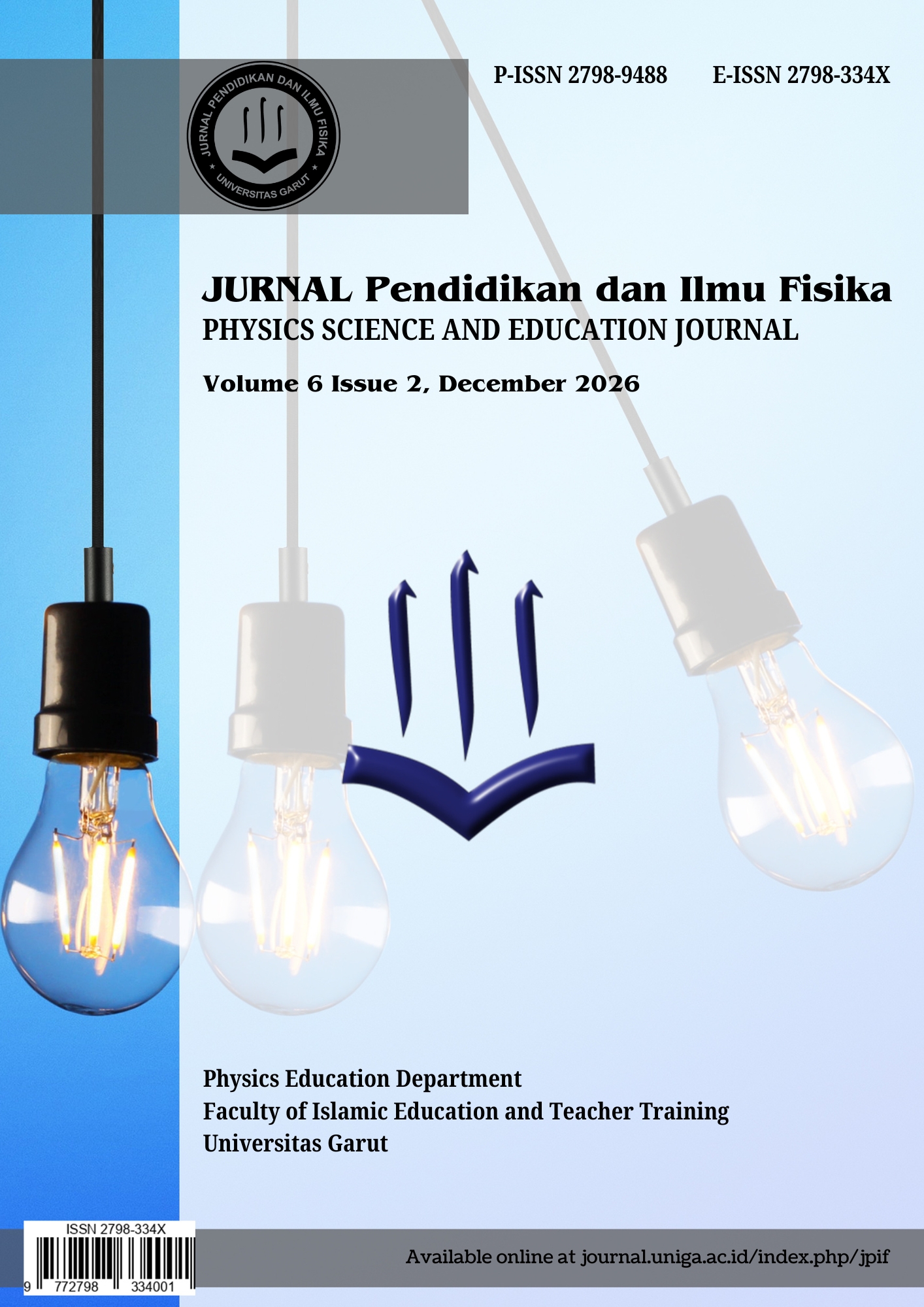
Artificial Intelligence and Internet of Things (AI-IoT) in Physics Education: A Bibliometric Analysis and Future Research Directions
DOI:
https://doi.org/10.52434/jpif.v6i2.44450Keywords:
artificial intelligence, bibliometric analysis, Internet of Things, physics educationAbstract
This study maps the research landscape of Artificial Intelligence and Internet of Things (AI-IoT) in physics education and identifies directions for future research. A bibliometric design combining performance analysis and science mapping was applied to 1,566 Scopus-indexed journal articles published between 2016 and 2026, selected following the PRISMA 2020 procedure. Five research questions guided the analysis: dataset profile and growth, country productivity and collaboration, intellectual base, conceptual structure, and thematic evolution. The corpus is young and growing quickly (annual growth rate 83.38%; average document age 1.44 years) and dispersed across 549 sources. China is the most productive country (286 articles), followed by Saudi Arabia, Indonesia, and the USA, while international co-authorship is only 28.67%. Co-citation analysis reveals two intellectual bases, namely AI in education and generative AI, and technology acceptance and survey methodology. Keyword mapping and thematic evolution show a shift from computer-aided instruction and machine learning toward learning systems, ChatGPT, and generative AI, whereas physics-specific and IoT terms remain peripheral. The findings point to the need for physics-grounded, pedagogically validated AI-IoT studies, particularly on sensor-based experiments, learning outcomes, generative AI, and data privacy, supported by broader international collaboration.
References
Al-Fuqaha, A., Guizani, M., Mohammadi, M., Aledhari, M., & Ayyash, M. (2015). Internet of Things: A survey on enabling technologies, protocols, and applications. IEEE Communications Surveys & Tutorials, 17(4), 2347–2376. https://doi.org/10.1109/COMST.2015.2444095
Aria, M., & Cuccurullo, C. (2017). bibliometrix: An R-tool for comprehensive science mapping analysis. Journal of Informetrics, 11(4), 959–975. https://doi.org/10.1016/j.joi.2017.08.007
Atzori, L., Iera, A., & Morabito, G. (2010). The Internet of Things: A survey. Computer Networks, 54(15), 2787–2805. https://doi.org/10.1016/j.comnet.2010.05.010
Bao, L., & Koenig, K. (2019). Physics education research for 21st century learning. Disciplinary and Interdisciplinary Science Education Research, 1, Article 2. https://doi.org/10.1186/s43031-019-0007-8
Chen, L., Chen, P., & Lin, Z. (2020). Artificial intelligence in education: A review. IEEE Access, 8, 75264–75278. https://doi.org/10.1109/ACCESS.2020.2988510
Cobo, M. J., López-Herrera, A. G., Herrera-Viedma, E., & Herrera, F. (2011). Science mapping software tools: Review, analysis, and cooperative study among tools. Journal of the American Society for Information Science and Technology, 62(7), 1382–1402. https://doi.org/10.1002/asi.21525
Crompton, H., & Burke, D. (2023). Artificial intelligence in higher education: The state of the field. International Journal of Educational Technology in Higher Education, 20, Article 22. https://doi.org/10.1186/s41239-023-00392-8
Davis, F. D. (1989). Perceived usefulness, perceived ease of use, and user acceptance of information technology. MIS Quarterly, 13(3), 319–340. https://doi.org/10.2307/249008
Donthu, N., Kumar, S., Mukherjee, D., Pandey, N., & Lim, W. M. (2021). How to conduct a bibliometric analysis: An overview and guidelines. Journal of Business Research, 133, 285–296. https://doi.org/10.1016/j.jbusres.2021.04.070
Freeman, S., Eddy, S. L., McDonough, M., Smith, M. K., Okoroafor, N., Jordt, H., & Wenderoth, M. P. (2014). Active learning increases student performance in science, engineering, and mathematics. Proceedings of the National Academy of Sciences, 111(23), 8410–8415. https://doi.org/10.1073/pnas.1319030111
Gubbi, J., Buyya, R., Marusic, S., & Palaniswami, M. (2013). Internet of Things (IoT): A vision, architectural elements, and future directions. Future Generation Computer Systems, 29(7), 1645–1660. https://doi.org/10.1016/j.future.2013.01.010
Hake, R. R. (1998). Interactive-engagement versus traditional methods: A six-thousand-student survey of mechanics test data for introductory physics courses. American Journal of Physics, 66(1), 64–74. https://doi.org/10.1119/1.18809
Holmes, W., Bialik, M., & Fadel, C. (2019). Artificial intelligence in education: Promises and implications for teaching and learning. Center for Curriculum Redesign.
Hwang, G.-J., Xie, H., Wah, B. W., & Gašević, D. (2020). Vision, challenges, roles and research issues of artificial intelligence in education. Computers and Education: Artificial Intelligence, 1, 100001. https://doi.org/10.1016/j.caeai.2020.100001
Kasneci, E., Sessler, K., Küchemann, S., Bannert, M., Dementieva, D., Fischer, F., Gasser, U., Groh, G., Günnemann, S., Hüllermeier, E., Krusche, S., Kutyniok, G., Michaeli, T., Nerdel, C., Pfeffer, J., Poquet, O., Sailer, M., Schmidt, A., Seidel, T., … Kasneci, G. (2023). ChatGPT for good? On opportunities and challenges of large language models for education. Learning and Individual Differences, 103, 102274. https://doi.org/10.1016/j.lindif.2023.102274
Kassab, M., DeFranco, J., & Laplante, P. (2020). A systematic literature review on Internet of things in education: Benefits and challenges. Journal of Computer Assisted Learning, 36(2), 115–127. https://doi.org/10.1111/jcal.12383
Lo, C. K. (2023). What is the impact of ChatGPT on education? A rapid review of the literature. Education Sciences, 13(4), Article 410. https://doi.org/10.3390/educsci13040410
Ma, J., & Nickerson, J. V. (2006). Hands-on, simulated, and remote laboratories: A comparative literature review. ACM Computing Surveys, 38(3), Article 7. https://doi.org/10.1145/1132960.1132961
Miao, F., & Holmes, W. (2023). Guidance for generative AI in education and research. UNESCO. https://unesdoc.unesco.org/ark:/48223/pf0000386693
Moral-Muñoz, J. A., Herrera-Viedma, E., Santisteban-Espejo, A., & Cobo, M. J. (2020). Software tools for conducting bibliometric analysis in science: An up-to-date review. Profesional de la Información, 29(1), Article e290103. https://doi.org/10.3145/epi.2020.ene.03
Page, M. J., McKenzie, J. E., Bossuyt, P. M., Boutron, I., Hoffmann, T. C., Mulrow, C. D., Shamseer, L., Tetzlaff, J. M., Akl, E. A., Brennan, S. E., Chou, R., Glanville, J., Grimshaw, J. M., Hróbjartsson, A., Lalu, M. M., Li, T., Loder, E. W., Mayo-Wilson, E., McDonald, S., … Moher, D. (2021). The PRISMA 2020 statement: An updated guideline for reporting systematic reviews. BMJ, 372, n71. https://doi.org/10.1136/bmj.n71
Rethlefsen, M. L., Kirtley, S., Waffenschmidt, S., Ayala, A. P., Moher, D., Page, M. J., & Koffel, J. B. (2021). PRISMA-S: An extension to the PRISMA statement for reporting literature searches in systematic reviews. Systematic Reviews, 10, Article 39. https://doi.org/10.1186/s13643-020-01542-z
Roll, I., & Wylie, R. (2016). Evolution and revolution in artificial intelligence in education. International Journal of Artificial Intelligence in Education, 26, 582–599. https://doi.org/10.1007/s40593-016-0110-3
Sethi, P., & Sarangi, S. R. (2017). Internet of Things: Architectures, protocols, and applications. Journal of Electrical and Computer Engineering, 2017, Article 9324035. https://doi.org/10.1155/2017/9324035
Small, H. (1973). Co-citation in the scientific literature: A new measure of the relationship between two documents. Journal of the American Society for Information Science, 24(4), 265–269. https://doi.org/10.1002/asi.4630240406
Staacks, S., Hütz, S., Heinke, H., & Stampfer, C. (2018). Advanced tools for smartphone-based experiments: phyphox. Physics Education, 53(4), 045009. https://doi.org/10.1088/1361-6552/aac05e
Tlili, A., Shehata, B., Adarkwah, M. A., Bozkurt, A., Hickey, D. T., Huang, R., & Agyemang, B. (2023). What if the devil is my guardian angel: ChatGPT as a case study of using chatbots in education. Smart Learning Environments, 10, Article 15. https://doi.org/10.1186/s40561-023-00237-x
van Eck, N. J., & Waltman, L. (2010). Software survey: VOSviewer, a computer program for bibliometric mapping. Scientometrics, 84(2), 523–538. https://doi.org/10.1007/s11192-009-0146-3
Venkatesh, V., Morris, M. G., Davis, G. B., & Davis, F. D. (2003). User acceptance of information technology: Toward a unified view. MIS Quarterly, 27(3), 425–478. https://doi.org/10.2307/30036540
Waltman, L., & van Eck, N. J. (2013). A smart local moving algorithm for large-scale modularity-based community detection. The European Physical Journal B, 86, Article 471. https://doi.org/10.1140/epjb/e2013-40829-0
Wieman, C. (2007). Why not try a scientific approach to science education? Change: The Magazine of Higher Learning, 39(5), 9–15. https://doi.org/10.3200/CHNG.39.5.9-15
Zawacki-Richter, O., Marín, V. I., Bond, M., & Gouverneur, F. (2019). Systematic review of research on artificial intelligence applications in higher education – where are the educators? International Journal of Educational Technology in Higher Education, 16, Article 39. https://doi.org/10.1186/s41239-019-0171-0
Zhai, X. (2021). Practices and theories: How can machine learning assist in innovative assessment practices in science education. Journal of Science Education and Technology, 30(2), 139–149. https://doi.org/10.1007/s10956-021-09901-8
Zhai, X., Chu, X., Chai, C. S., Jong, M. S. Y., Istenic, A., Spector, M., Liu, J.-B., Yuan, J., & Li, Y. (2021). A review of artificial intelligence (AI) in education from 2010 to 2020. Complexity, 2021, Article 8812542. https://doi.org/10.1155/2021/8812542
Zhai, X., He, P., & Krajcik, J. (2022). Applying machine learning to automatically assess scientific models. Journal of Research in Science Teaching, 59(10), 1765–1794. https://doi.org/10.1002/tea.21773
Zupic, I., & Čater, T. (2015). Bibliometric methods in management and organization. Organizational Research Methods, 18(3), 429–472. https://doi.org/10.1177/1094428114562629
Downloads
Published
Issue
Section
License
Copyright (c) 2026 Anderias Henukh, Amzal Heri, Tutik Yuliatun, Momna Khattak

This work is licensed under a Creative Commons Attribution 4.0 International License.