Allegation of Research Misconduct
Correction and Retraction Policy

Jurnal Pendidikan dan Ilmu Fisika (JPIF) provides immediate open access to its published articles to support the free exchange of scientific knowledge. Readers can access and download the full text without subscription fees or registration.
Published articles are licensed under the Creative Commons Attribution 4.0 International License (CC BY 4.0), which permits sharing and adaptation, including for commercial purposes, provided that appropriate credit is given, a link to the license is included, and any changes are indicated.
Jurnal Pendidikan dan Ilmu Fisika (JPIF) applies a double-blind peer-review process, in which the identities of authors and reviewers are concealed from one another during the review. Peer review supports the editorial assessment of a manuscript’s scientific quality, originality, and contribution to physics and physics education.
Submitted manuscripts are first checked for alignment with the journal’s focus and scope, compliance with the author guidelines, completeness, clarity, and originality. Similarity screening forms part of this assessment. Manuscripts that do not meet the journal’s requirements may be returned for improvement or rejected before external peer review.
Manuscripts that pass the initial screening are assigned to reviewers with expertise relevant to their subject matter. Reviewer selection considers appropriate expertise and potential conflicts of interest.
Reviewers assess the manuscript’s originality, relevance, methodological soundness, quality of analysis, interpretation of findings, and clarity of presentation. For review articles and other manuscript types, the assessment is adapted to the nature and purpose of the submission.
Reviewer comments and recommendations inform the editor’s decision. The authority to accept or reject a manuscript rests with the editor.
Following assessment, the editor communicates the decision and relevant comments to the authors. Decisions may include acceptance, minor revision, major revision, or rejection.
Authors asked to revise their manuscript should submit a revised version and a point-by-point response explaining how each comment has been addressed. Where a suggestion is not adopted, the authors should provide a reasoned explanation.
The editor assesses the revised submission and may return it to reviewers for further evaluation. Additional revisions may be requested when necessary. An invitation to revise does not guarantee acceptance.
Manuscripts are accepted when the editor determines that they meet the journal’s publication requirements, taking the reviewers’ recommendations and the authors’ revisions into account.
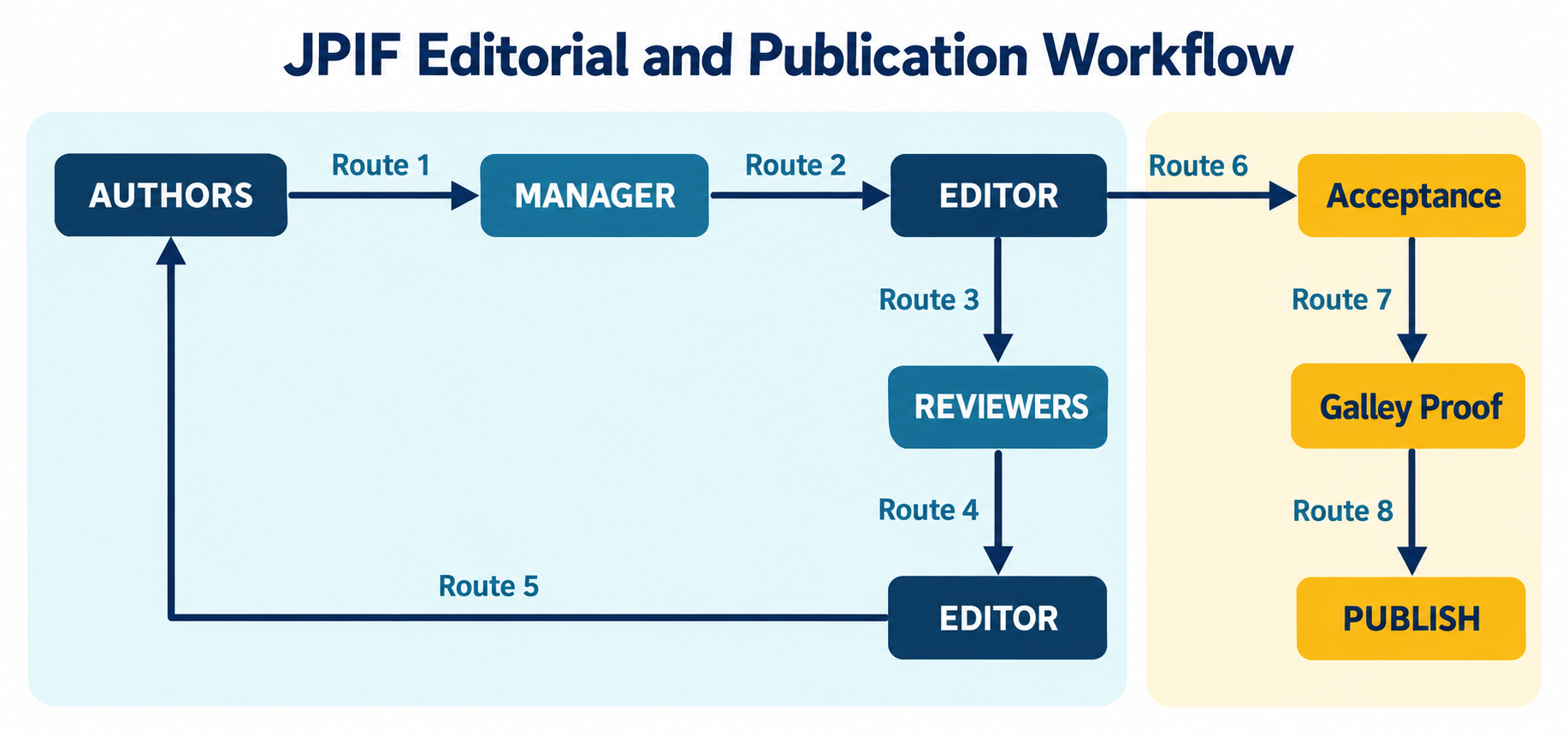
Accepted manuscripts proceed to editing and preparation of the galley proof. Authors are asked to check the proof for accuracy and report any necessary corrections before publication. Substantial changes at this stage require editorial approval and may require further assessment. The peer-review and publication workflow is presented in the following figure.
The ethical responsibilities of authors, editors, and reviewers, including confidentiality, objectivity, conflicts of interest, and timely responses, are described in the journal’s Publication Ethics policy.
Jurnal Pendidikan dan Ilmu Fisika (JPIF) is committed to maintaining the accuracy and integrity of its published articles. Errors or concerns identified after publication will be assessed by the editorial team to determine the appropriate action.
A correction may be published when an error affects a limited part of an article while its overall findings remain reliable. This includes misleading information resulting from an honest error, as well as inaccuracies in the author or contributor list, such as the omission of an eligible author or the inclusion of someone who does not meet the authorship criteria.
Corrections and supplementary notices may take the following forms:
The editor will contact the authors for clarification and may consult reviewers or editorial board members. The final decision on whether a notice is required and which form it should take rests with the editor.
Published notices will explain the changes and be linked to the original article. Significant changes will not be made without an accompanying notice.
JPIF may retract a published article when there is clear evidence that:
The editor will assess the available evidence and normally seek an explanation from the authors before making a decision. The process will be guided by the Committee on Publication Ethics (COPE) Retraction Guidelines.
A retraction notice will identify the article, explain the reason for retraction, and state who is retracting it. The notice will be linked to the original article, which will normally remain accessible and be clearly marked as retracted.
The full text of a published article may be removed only in exceptional circumstances, such as when removal is required by a court order, the content infringes legal rights or is defamatory, or continued availability presents a serious health or safety risk.
Where legally permissible, the article’s title, author information, and other bibliographic details will remain available. A notice explaining the removal will replace the full text.
In exceptional cases involving a serious health or safety risk, an article may be retracted and replaced with a corrected version. The replacement will undergo appropriate editorial assessment and, where necessary, further peer review.
The retraction notice will link to the corrected publication, and the relationship between the original and replacement versions will be clearly documented.
Authors and readers should report errors or concerns to jpif@uniga.ac.id, providing the article title, DOI, an explanation of the issue, and supporting evidence.
Bahasa Indonesia:

English:











P-ISSN
E-ISSN